Cinema Studio: What Higgsfield Actually Built When Everyone Else Was Wrapping Models
Higgsfield published an inside story about how Cinema Studio was built. I read it twice, because underneath the anecdotes there is one of the cleanest answers I have seen to the question every AI product team is currently losing sleep over: when the model underneath you changes every eight weeks, what exactly are you building?
Here is the story, and then what I think it teaches.
It started with an aspect ratio nobody was using
November 2025. A new image model ships, and Higgsfield runs its standard drill — the whole creative team stress-tests it to find out what it can do. One of their creatives, Sula, notices something in the noise: everybody on Twitter is generating in 3:4 and 4:3. Nobody is generating in 21:9.
So he does. He builds a frame in cinema format, animates it, and the output is immediately different — richer, more filmic. To push further, he starts writing the names of real cameras into his prompts. It works.
By lunchtime he has a clip of a kangaroo squaring up for a fight inside an octagon. A million views in two days.
The team sees it and knows instantly it should be a product. There is only one problem, and it is the whole reason Cinema Studio exists: nobody else could reproduce it. The product lead, Axultan, tried what he thought was the same thing and got, in his words, slop.
When the prompt engineers took Sula's prompts apart, they found them unusually loaded with technical vocabulary — not scene, not story, but cameras, optics, light. One word kept recurring that Axultan didn't even know was a camera brand.
The explanation is simple and, once you hear it, obvious. Frontier models train on enormous volumes of video, decades of cinema included. The cinematic visual language is already inside them. Naming a specific camera and lens lands far more precisely than asking, in ordinary words, for something beautiful. Sula didn't invent the magic. He found the address it lives at.
That single insight is the product thesis: instead of describing a look in words, you build the frame the way a cinematographer does — pick a camera, mount a lens, set the focal length — with the knowledge that makes those choices work already baked in underneath.
The 200 people you don't see
Most companies would answer "how does a normal person learn to speak like a cinematographer?" with user research. Higgsfield answered it internally, because film was in the company from the start. They had been hiring directors, cinematographers and editors for a long time; the creative team is now around 200 people.
And almost all of that expertise went into the part of the product no user will ever see.
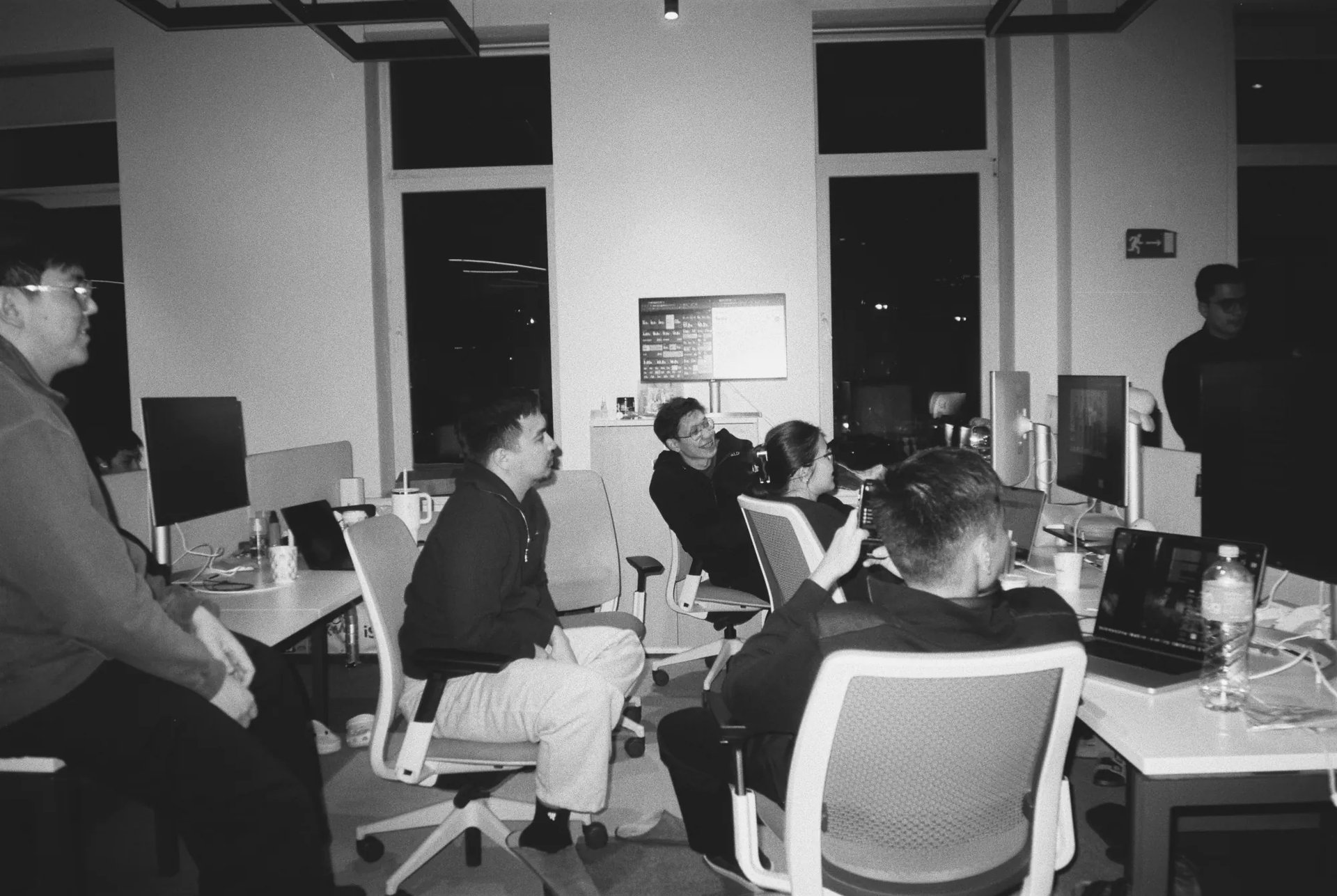 Higgsfield's own photos of the team behind Cinema Studio. Source: Inside Higgsfield #1.
Out of everything a cinematographer touches on set — cameras, optics, light, filters, movement — version one kept three settings: camera, lens, focal length. Everything else was cut. As the article notes, deciding what to cut was the hard part, because working out what a person genuinely needs takes far longer than listing everything they might want.
That job went to Danil Kim, their creative team lead, a former director of photography who used to deliver camera equipment to real film sets. Two details in how he worked are worth stealing:
He didn't trust his own eye alone. With the prompt engineers, he ran camera-and-optics combinations through the model, reviewed the output, then sent footage to working camera operators he knew and asked one question: does this look AI to you? Whatever failed the check was cut — including legendary lenses whose names carry real weight, dropped the moment the model couldn't reproduce their effect. Brand equity lost to a blind test.
 The unglamorous version of "curating a camera pool": running combinations through the model and looking at the output, frame by frame.
Then came the harder problem. Early on, nearly every lens looked the same in generation. That is fatal for a product whose entire premise is that the choice of lens matters. A cinematographer picks a specific lens for a specific feeling, and the feeling wasn't coming through.
So the team went lens by lens, pulled the character out of each piece of glass, and amplified it — in places deliberately exaggerated it — until choosing one lens over another visibly changed the shot. "Obviously it's not the same as shooting on a real camera and real optics," Danil says. "So we looked for each lens's character, and we amplified it."
Nobody using Cinema Studio will ever know a lens was tuned by hand. That was the point.
Around those three settings, two more people built the surface you touch: a product designer, Assylzhan, turned them into a switcher — open the camera picker, roll the wheel, match a lens to the camera and a focal length to the lens — built to feel like loading a real rig. An engineer, Kuanysh, built tracing, so settings and metadata travel with the generated image: drop that frame in as the first frame of a video and the whole look carries over.
Version one shipped December 18, 2025. Roughly one month from viral clip to product.
The release they'd take back
Then the version history, which reads like a compressed lesson in shipping cadence:
- 1.5 — aperture as a fourth core control, plus recommended camera presets.
- 2.0 / 2.5 — Elements, 3D Scene, Character Motions, locations, Soul Cinema. The product moves from one strong frame toward whole scenes.
- 3.0 — April. A new state-of-the-art video model lands and the entire industry scrambles to integrate it at once. Higgsfield ships 3.0 into that chaos knowing it won't go smoothly. It doesn't. They call it the most turbulent release in the product's history and say plainly that they didn't like some of those decisions afterward.
- 3.5 — ten days later.
Ten days. That number is the whole argument of the article, and the reason is worth reading twice:
The cameras, the lenses, the character of the glass — none of it was welded to a particular model. The core model underneath changed, and the craft stayed exactly where it was.
Not a single preset broke. The craft layer was portable, so a model swap was a substitution, not a rebuild.
 The team that shipped 3.5 ten days after 3.0.
From a frame to a film
Almost everything in 3.5 grew from one new capability: the model could generate long scenes made of several shots.
Once you have multishot, a single continuous camera movement stops meaning anything — so camera control moved up a level of abstraction. You choose a genre, and the camera moves the way that genre moves: cutting like action, holding like drama. The same fact killed the still-then-animate workflow: if the model can carry a whole scene, generate video-first. Set camera, lens, focal length, aperture — shoot straight to video.
Footage generated in Cinema Studio, from the original Higgsfield post.
Two more things from that release stayed with me.
The enhancer as a credit-saving device. Sabatovsky, an R&D prompt engineer, builds for users who arrive with three-word prompts or physically impossible ones — his favourite being "generate me a 50-shot battle scene in 15 seconds." His stated goal: "You come in, you don't strain yourself much, and you get something delicious on the first batch. Fourth at worst." Without that, users burn credits iterating blindly. In a metered product, first-batch quality is the pricing.
Projects, borrowed from how shoots actually work. A cinematographer settles on an equipment package before production and carries it through the film. So: start a project — a 90s action movie, a western — and light, optics and tempo hold across every generation inside it. Style chosen once instead of re-prompted forever.
And one thing they didn't do: retire old versions. The plan was to sunset them as new ones shipped, but users asked to keep generating on 2.5, and Gani, who runs their Discord, brought that request in. Version selection now lives inside the tool. A community manager overturned a roadmap decision — a small detail that tells you a lot about how the company is wired.
4.0 continues the same direction: up to 720p, generations up to 30 seconds, Montage Pacing, AI Cast, Cinematic Locations, Soul Cinema models, multi-model support, and an anti-slop camera pipeline. AI Director, introduced in 3.5, outgrew Cinema Studio entirely and became its own product, Supercomputer.
What I actually take from this
1. The durable layer is not the model, and it is not the UI either. It is the translation between them. Higgsfield owns the mapping from human creative intent ("I want this to feel like a 90s action film") to the exact tokens this generation of models responds to. Models get replaced; that mapping gets inherited. Ten days from a bad release to a good one is what owning that layer buys you.
2. Taste is a data asset if you make it one. 200 film people is a hiring cost. Two hundred film people whose judgment has been distilled into a curated camera pool, hand-amplified lens characters, and genre-based camera behaviour is a moat — because it is embedded in the product, not in a Slack channel.
3. Blind-test your own expertise. "Does this look AI to you?" asked of working camera operators, with famous lenses cut when they failed, is a rigour most AI products skip. Everyone reviews their own outputs. Almost nobody hands them to a professional who does the real thing for a living and takes the answer literally.
4. Constraint is the feature. From everything on a film set down to three controls. The article is honest that cutting was harder than building, and that is exactly right: the cost of a feature is never the code, it's what it does to the decision the user has to make.
5. First-batch quality is the business model. When every attempt costs credits, a prompt enhancer isn't a nicety — it's the difference between a user who renews and a user who feels robbed.
The bet Higgsfield states at the end is deliberately modest. Nobody there thinks everyone becomes a director. The bet is that one person, with taste and patience and a tool that speaks the language of cinema, makes a genuinely good film start to finish.
Or as Axultan puts it, on the question of whether they killed art: they didn't kill art, they changed who gets the right to make it. Making a film always meant commanding serious capital — cameras, crews, distribution — and the gatekeeping in cinema was never creative. It was financial.
From a kangaroo generated at five in the morning to a filmmaking system, in roughly nine months. The lesson isn't the kangaroo. It's that they knew which part of it to keep.
Source, photos and footage: Inside Higgsfield #1: How We Built Cinema Studio. All images and video © Higgsfield, used here for commentary.